Gospel Doctrine for the Godless

An ex-Mormon take on LDS Sunday School lessons

Month: November 2014

OT Lesson 45 (Daniel 1, Esther)

“If I Perish, I Perish”

Daniel 1; 3; 6; Esther 3–5; 7–8

LDS manual: here

Reading

God’s been terrible lately in the Old Testament. He’s been messing around with his prophets, making them do weird things, and basically threatening to kill the whole world. I’ve just been waiting to see if he’ll do something nice for someone, sort of like Erin Brockovich’s boyfriend did before he left. Well, in this lesson, we finally get to see the nicer side of Jehovah, with the stories of Daniel and Esther.

Ch. 1: Daniel and friends are captured by the Babylonians, who are surprised to find that Jews can be vegan. The prince of the eunuchs asks, “Where do you get your protein?” He doesn’t want them to keep their diet, but in a sudden burst of science, a test is proposed, and Daniel and his friends look healthier than the kids who eat meat.

Ch. 3: Daniel’s friends Shadrach, Meshach, and Abednego refuse to worship king Nebuchadnezzar’s idol, and are cast into a fiery furnace. Because the fire’s so hot, it kills the men throwing them in. But that’s collateral damage, and they’re not Jews anyway, so it doesn’t count. This begins a long tradition of not caring much about minions.

The king looks into the fire and sees:

3:25 He answered and said, Lo, I see four men loose, walking in the midst of the fire, and they have no hurt; and the form of the fourth is like the Son of God.

This verse is noteworthy for the appearance of the concept of God having a son, but what’s really impressive is how perceptive Nebuchadnezzar is. How was he supposed to know what the Son of God would look like? There’s only one explanation: everyone in this story is freaking high.

Ch. 6: Daniel himself is thrown to the lions when he prays in defiance of the king. Nothing bad happens to him because God always intervenes in favor of those who believe in him.

Wait, does that mean that God just nullified the agency of everyone who saw the event? It must have been such an amazing rescue that those who saw it would have no choice but to believe! At least, that’s what people always tell me when I ask why God can’t give sufficient evidence for his existence. God requires faith, which evidence would nullify.

But this is a silly rationale. The scriptures are full of stories like this, where God rescues people who have faith in him. So if you have faith, but you don’t get rescued, you might well ask: What am I, chopped liver? Unless you die, in which case you can’t ask anything at all. And this is why God seems better than he is: lots of people are walking around thinking God saved them; dead people aren’t around to give the other side of the story.

There’s nothing supernatural about the story of Esther; in fact, terms like God and Lord never appear. As a consequence, it’s quite enjoyable to read. It’s rather similar to Daniel in theme: the Jews are threatened with extinction, but Esther saves the day. This will get rebooted into tales of destruction in the Book of Mormon, including burning the people of Ammonihah alive (Alma 14), and the wicked Nephites planning to put all the believers to death (3 Ne 1)

Main points from this lesson

God protects his people, but don’t expect protection

The king asks Shadrach, Meshach, and Abednego what they’ll do if he decides to burn them. And where’s their god now?

3:15 Now if ye be ready that at what time ye hear the sound of the cornet, flute, harp, sackbut, psaltery, and dulcimer, and all kinds of musick, ye fall down and worship the image which I have made; well: but if ye worship not, ye shall be cast the same hour into the midst of a burning fiery furnace; and who is that God that shall deliver you out of my hands?

The answer of the boys is interesting.

3:16 Shadrach, Meshach, and Abednego, answered and said to the king, O Nebuchadnezzar, we are not careful to answer thee in this matter.
3:17 If it be so, our God whom we serve is able to deliver us from the burning fiery furnace, and he will deliver us out of thine hand, O king.
3:18 But if not, be it known unto thee, O king, that we will not serve thy gods, nor worship the golden image which thou hast set up.

As a believer, this always seemed very moderate and mature. You shouldn’t expect God to protect you. As Neil Maxwell said,

“We will [not] always be rescued from proximate problems, but we will be rescued from everlasting death!”

Meanwhile, Neil Maxwell is still dead.

To me now, this seems like a dodge. You might expect God to protect you, but if he doesn’t feel like it for some reason, that doesn’t mean he’s failed or he doesn’t exist or anything. It’s a good excuse for explaining away a lack of results, or explaining why a god who does nothing might possibly exist.
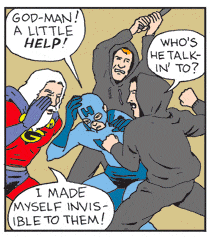
Click to continue to the rest of the comic.

So which is it? If he doesn’t intervene, how can they be sure he exists? And if he does intervene, why does he do so in such a selective fashion?

Persecution complexes

As a kid in the Mormon Church, there were two doctrinal constants:

  • Don’t ever drink alcohol
  • They’re coming to get us.

No shit; some teacher once tried to terrify a class full of us by telling a hypothetical story about how our neighbours went berserk and decided to burn all the Mormons to death in a huge fire — naming each of us by name during the story — and would we be strong enough to be killed for our faith? WOULD WE?

What I didn’t realise was that our neighbours couldn’t have cared less about our goofy religion; they just wished we wouldn’t bug them so much about it. That didn’t stop us from incorporating imaginary future persecution into our worldview.

After all, why was Joseph Smith persecuted? This was never clear to me as a Mormon kid, though it seemed to be satanic in origin. I’d often hear that Joseph could have made the persecution stop at any time, just by denying the Book of Mormon and the First Vision — and that means he really believed it and it must be true. Post-polygamy-essays, I now see that for the distortion it is. If Joseph had denied the Book of Mormon or the First Vision, that wouldn’t have stopped the persecution because the persecution was never about those things. He was persecuted because he was bilking people out of their money, abusing his position as a religious leader, marrying girls and wives, planning the assassination of a governor, and destroying printing presses. Trumped-up charges? Hardly.

The early Mormons were persecuted in Illinois and Missouri, but this didn’t exactly come out of nowhere, nor was it entirely unreciprocated. Here’s a page listing some of the factors — Caution: it’s a Christian site.

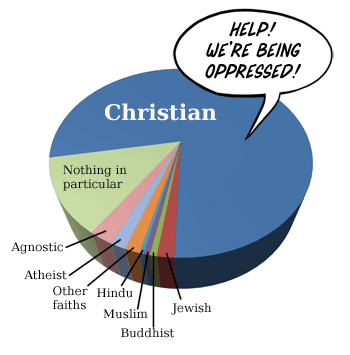
The two stories in today’s reading are used to fuel paranoia and a persecution complex among believers. In the story of Daniel, anyone who refuses to worship Nebuchadnezzar’s image gets the fiery furnace, and anyone who prays gets lions.

As for Esther, Haman gets king Ahasuerus to agree to genocide against the Jews.

3:13 And the letters were sent by posts into all the king’s provinces, to destroy, to kill, and to cause to perish, all Jews, both young and old, little children and women, in one day, even upon the thirteenth day of the twelfth month, which is the month Adar, and to take the spoil of them for a prey.

Note that in past chapters, when the Israelites are commanded to commit genocide against their neighbours, this is just another day in the Old Testament. But when it’s the Jews thenselves that are endangered, this is meant to be biblically terrible. At this stage, having read this much of the OT, this kind of myopia shouldn’t be surprising.

Let’s not forget that in many places in the world, religious persecution is very real, against Christians, against Jews, against all sorts, including atheists.
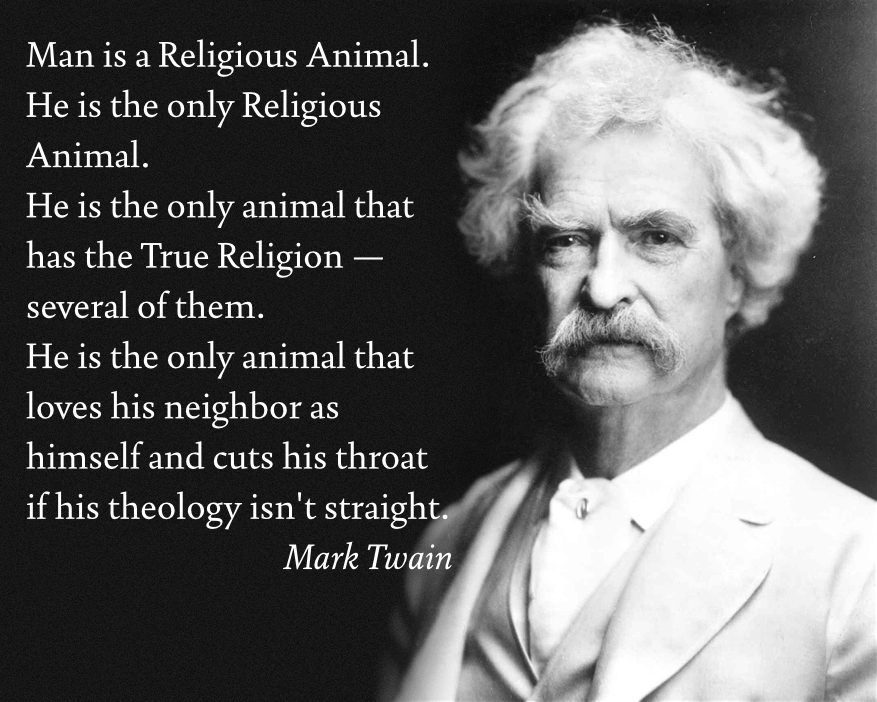
That aside, imagining persecution is one thing that American Christians are really good at. It’s given rise to the War on Christmas, in which Christians imagine that their 11-month holiday, enthusiastically celebrated by everyone, is being prohibited because they can’t force everyone to make it explicitly Christian.

All too often, it’s Christians who are unwilling to give up the religious privilege that they’ve historically enjoyed. Here are Christians interrupting a public prayer in the US Senate when it’s a Hindu’s turn.

and here’s a Christian interrupting a Muslim giving a prayer at a Christian cathedral.

Even Buddhists, who many of us would consider placid and tolerant, can become murderous when their dominance is threatened.

It’s especially rich when US Christians claim that persecution is happening at the hands of atheists.

In the words of this possibly fictional youth pastor:

Ask: What can we learn from these cases?
Answers: Religious majorities can very easily become tyrannical.

Read Article 18 of the UN Declaration of Human Rights. What does it say about religion?

Everyone has the right to freedom of thought, conscience and religion; this right includes freedom to change his religion or belief, and freedom, either alone or in community with others and in public or private, to manifest his religion or belief in teaching, practice, worship and observance.

Notice also Article 20:

(2) No one may be compelled to belong to an association.

Atheists and non-believers must be committed (somewhat ironically) to upholding religious pluralism and the right to join, leave, or switch to any religion (or none), while upholding secular principles in government, schools, and workplaces.

OT Lesson 44 (Ezekiel 2)

“Every Thing Shall Live Whither the River Cometh”

Ezekiel 43–44; 47

LDS manual: here

Reading

Short lesson this week, finishing up Ezekiel.

Before we get into this lesson, let’s take a moment for some news: Last week or so, the LDS Church released a shelf-breaking essay on its website about polygamy in Kirtland and Nauvoo. Reactions among the membership have ranged from “not knowing about it” to “having known about it all along“.

In the wake of this and other essays, the church has released a new article called, “Shelve It and Trust God.”

No, no, that’s not the title The title is actually, “The Answer to All the Hard Questions“.

In previous lessons, I’ve mentioned three of the most destructive scriptures in the OT, and this new article uses two of them. Let’s see how.

Principle 1: God Knows Infinitely More Than We Do. When faced with questions—whether personal, social, or doctrinal—we can rely on the fact that the Creator of the universe knows far more than we do. If He has addressed a topic (and sometimes He hasn’t), we can trust that His views are clearer than ours.
“For my thoughts are not your thoughts, neither are your ways my ways, saith the Lord.
“For as the heavens are higher than the earth, so are my ways higher than your ways, and my thoughts than your thoughts”
(Isaiah 55:8–9).
Principle 2: God Shares Some of His Knowledge. A corollary of principle 1 is that God shares with us as much of what He knows as we are ready to receive and He is ready to deliver. We just need to prepare ourselves to receive it, then seek it. The scriptures answer many questions. One of the great pleasures of this life is being taught by the Holy Ghost as He uses the scriptures to reveal “line upon line, precept upon precept, here a little and there a little” (2 Nephi 28:30) in response to our diligent study.

What function do they serve here? They tell the reader two things.

  • The first one says, “Don’t listen to what you think is right; listen to God (or really, his earthly surrogates).”
  • The second one says, “If it seems like we’re making stuff up as we go, that’s all part of the plan!”

Watch for a lot more of these two verses.

There’s not really much to say about the rest of Ezekiel. It’s just a list of cities God’s going to kill. And when he’s killed everyone, then they’ll know he’s God.

33:29 Then shall they know that I am the LORD, when I have laid the land most desolate because of all their abominations which they have committed.

Why was he going to kill them? What had they done?

36:16 Moreover the word of the LORD came unto me, saying,
36:17 Son of man, when the house of Israel dwelt in their own land, they defiled it by their own way and by their doings: their way was before me as the uncleanness of a removed woman.

Jehovah / Jesus seems horrified by women. He even kills Ezekiel’s wife, and tells him not to cry.

24:15 Also the word of the LORD came unto me, saying,
24:16 Son of man, behold, I take away from thee the desire of thine eyes with a stroke: yet neither shalt thou mourn nor weep, neither shall thy tears run down.
24:17 Forbear to cry, make no mourning for the dead, bind the tire of thine head upon thee, and put on thy shoes upon thy feet, and cover not thy lips, and eat not the bread of men.
24:18 So I spake unto the people in the morning: and at even my wife died; and I did in the morning as I was commanded.

That’s a bit sad.

The melancholy drives Ezekiel to architecture, as he watches an angel measure the new temple with a reed, in great detail.

40:2 In the visions of God brought he me into the land of Israel, and set me upon a very high mountain, by which was as the frame of a city on the south.
40:3 And he brought me thither, and, behold, there was a man, whose appearance was like the appearance of brass, with a line of flax in his hand, and a measuring reed; and he stood in the gate.
40:4 And the man said unto me, Son of man, behold with thine eyes, and hear with thine ears, and set thine heart upon all that I shall shew thee; for to the intent that I might shew them unto thee art thou brought hither: declare all that thou seest to the house of Israel.
40:5 And behold a wall on the outside of the house round about, and in the man’s hand a measuring reed of six cubits long by the cubit and an hand breadth: so he measured the breadth of the building, one reed; and the height, one reed.

And on and on for many chapters.

I get kind of ticked when I read this for some reason. Here’s God’s chance to say what’s really important, and he devotes chapters and chapters on how to build a building for him, and how to kill animals for him the right way. I could give about twenty better things for God to have said just off the top of my head; any normal person could.

  • Don’t have slaves.
  • Genocide is wrong.
  • Women and men and equal.

And so on. It’s frustrating beyond madness.

Main points from this lesson

The Hosanna Shout

Most of this lesson is about the temple and how wonderful it is. (No mention of how repetitive or pointless it is.)

But then it transitions into a discussion of the Hosanna Shout. Here’s the LDS lesson manual.

• Have you ever been excited while watching a sporting event or some other kind of entertainment?
• Have you ever been so excited at such an event that you stood and shouted or cheered?
• What is a sacred event in the Church where participants show their joy and gratitude by standing, shouting, and waving? (During the dedication of a temple, the congregation participates in a great expression of joy called the Hosanna Shout.)

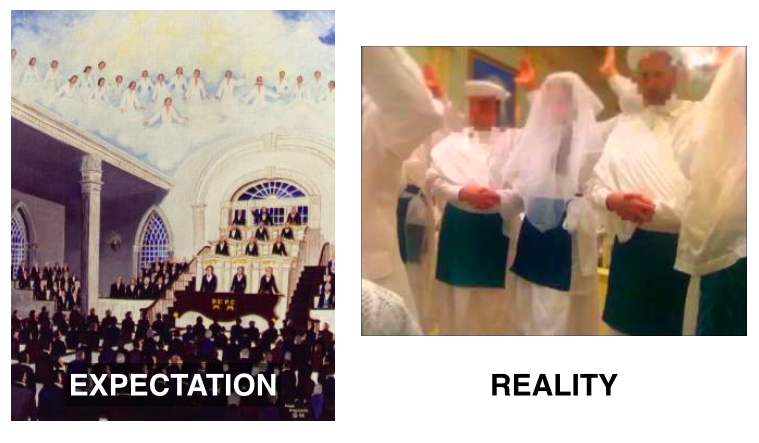
Wow, this sounds exciting! It sounds invigorating! It sounds… totally unlike anything in my LDS experience.

But in church history, the Hosanna Shout was a really big deal. Mormons performed it at the dedication of the Kirtland temple.

Eliza R. Snow wrote, “The ceremonies of that dedication may be rehearsed, but no mortal language can describe the heavenly manifestations of that memorable day. Angels appeared to some, while a sense of divine presence was realized by all present, and each heart was filled with joy inexpressible and full of glory.” After the prayer, the entire congregation rose and, with hands uplifted, shouted hosannas “to God and the Lamb.”

Would you like to see this exciting event on video? Here it is!

Woo hoo!

When I did the Hosanna Shout, I’d heard the Kirtland story, I’d gotten the build-up, and I thought it would be incredible. Then when I actually did it, with grown adults waving these handkerchiefs in the air and looking ridiculous, I thought, “What did we just do‽”

It was just another case of expectations not matching reality.

OT Lesson 43 (Ezekiel 1)

The Shepherds of Israel

Ezekiel 18; 34; 37

LDS manual: here

Reading

We’ve seen some wild behaviour from prophets in the Old Testament. We’ve seen performance art from Jeremiah, a serious cuckold fetish from Hosea, and the bear-tearing hijinx of Elisha. But now we’re going to see the most truly psychotic prophet of all, Ezekiel.

With that comment, I mean no disrespect to people with mental illness. It’s a real problem, and one that can be treated and managed with the help of modern medicine. But Ezekiel didn’t have the benefit of such treatment — and was hailed as a prophet for his erratic behaviour and his deranged rantings. What does it tell us about a society when its craziest people are held up as heroes?

Okay, I just took a look at our society, and you don’t have to answer that question.

But still, Ezekiel is the kind of guy you have to keep a tight leash on. The book of Ezekiel has 48 chapters, and the LDS lesson manual only wants you to read six of them. Why? Steve’s list of the weird bits is not to be missed, but here’s my list of highlights:

• Ezekiel had to build a little fort to besiege the city of Jerusalem, represented by a tile. This was more difficult than it may seem; couch cushions were rare in that region.

4:1 Thou also, son of man, take thee a tile, and lay it before thee, and pourtray upon it the city, even Jerusalem:
4:2 And lay siege against it, and build a fort against it, and cast a mount against it; set the camp also against it, and set battering rams against it round about.
4:3 Moreover take thou unto thee an iron pan, and set it for a wall of iron between thee and the city: and set thy face against it, and it shall be besieged, and thou shalt lay siege against it. This shall be a sign to the house of Israel.

• Then he had to lay on his left side for 390 days, and then he got to turn over and lay on his right side for 40 days.

4:4 Lie thou also upon thy left side, and lay the iniquity of the house of Israel upon it: according to the number of the days that thou shalt lie upon it thou shalt bear their iniquity.
4:5 For I have laid upon thee the years of their iniquity, according to the number of the days, three hundred and ninety days: so shalt thou bear the iniquity of the house of Israel.
4:6 And when thou hast accomplished them, lie again on thy right side, and thou shalt bear the iniquity of the house of Judah forty days: I have appointed thee each day for a year.

• He had to bake bread in an unusual manner. Have you ever seen that Ezekiel 4:9 bread?

It’s based on this passage:

4:9 Take thou also unto thee wheat, and barley, and beans, and lentiles, and millet, and fitches, and put them in one vessel, and make thee bread thereof, according to the number of the days that thou shalt lie upon thy side, three hundred and ninety days shalt thou eat thereof.

Well, that sounds pretty good. I don’t mind barley, or even millet. (I’ve never eaten a fitch.)

But for some reason, the makers of this bread don’t print the method of cooking on the packet.

4:12 And thou shalt eat it as barley cakes, and thou shalt bake it with dung that cometh out of man, in their sight.
4:13 And the LORD said, Even thus shall the children of Israel eat their defiled bread among the Gentiles, whither I will drive them.

Yep, bread cooked over a fire made with human dung.

If you’d like some help making your own Ezekiel bread, you can try this book:

Oh, but that’s not all. You’ll remember that Jeremiah portrayed Israel as a harlot. Well, old Ezekiel takes it over the cliff.

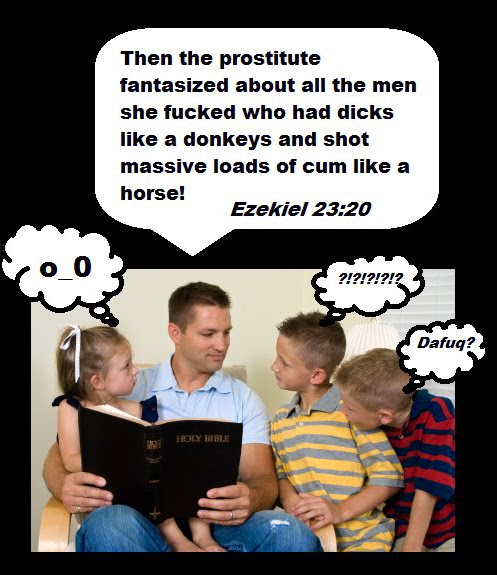
23:20 For she doted upon their paramours, whose flesh is as the flesh of asses, and whose issue is like the issue of horses.

Or as the NIV has it:

There she lusted after her lovers, whose genitals were like those of donkeys and whose emission was like that of horses.

Or as the Internet has it:

Main points from this lesson

The sin of Sodom

Many times, I’ve had Mormons (and Christians) defend their anti-gay bigotry by making reference to the destruction of Sodom. Clearly the people of Sodom were doing something terrible. 
Well, in Ezekiel, Jehovah explains what the “sin of Sodom” was.

16:49 Behold, this was the iniquity of thy sister Sodom, pride, fulness of bread, and abundance of idleness was in her and in her daughters, neither did she strengthen the hand of the poor and needy.
16:50 And they were haughty, and committed abomination before me: therefore I took them away as I saw good.

It’s very instructive that sins like pride and not taking care of the poor appear on this list, but homosexuality does not (unless it’s coming in under the general category of ‘abomination’). Something you can toss into a discussion when it comes up.

Sticks of Judah and Joseph

Ezekiel 37 contains probably the clearest example of the way Mormons cherry-pick from the Bible. All through my youth, I heard that the Bible prophesied of the coming forth of the Book of Mormon, based on this scripture:

37:15 The word of the LORD came again unto me, saying,
37:16 Moreover, thou son of man, take thee one stick, and write upon it, For Judah, and for the children of Israel his companions: then take another stick, and write upon it, For Joseph, the stick of Ephraim and for all the house of Israel his companions:
37:17 And join them one to another into one stick; and they shall become one in thine hand.

What could this mean? The LDS lesson manual rather blithely states

• How has the prophecy in Ezekiel 37:15–20 been fulfilled? (See 1 Nephi 5:14; 2 Nephi 3:12; D&C 27:5. Explain that the word stick in these verses refers to a type of wooden writing tablet commonly used in Ezekiel’s day. The stick of Judah symbolizes the Bible, and the stick of Joseph symbolizes the Book of Mormon.)

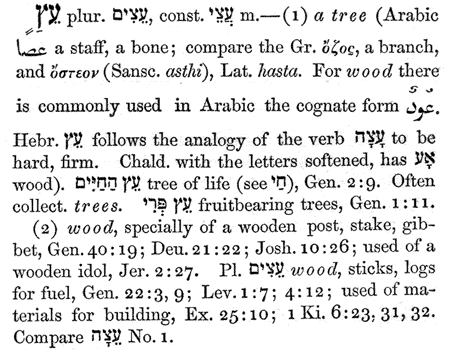
A wooden writing tablet? I don’t speak Hebrew, but that isn’t one of the meanings in Strong’s. It just refers to trees, or actual sticks.

But that doesn’t really matter. All we have to do is keep reading to see what Ezekiel meant:

37:18 And when the children of thy people shall speak unto thee, saying, Wilt thou not shew us what thou meanest by these?
37:19 Say unto them, Thus saith the Lord GOD; Behold, I will take the stick of Joseph, which is in the hand of Ephraim, and the tribes of Israel his fellows, and will put them with him, even with the stick of Judah, and make them one stick, and they shall be one in mine hand.
37:20 And the sticks whereon thou writest shall be in thine hand before their eyes.
37:21 And say unto them, Thus saith the Lord GOD; Behold, I will take the children of Israel from among the heathen, whither they be gone, and will gather them on every side, and bring them into their own land:
37:22 And I will make them one nation in the land upon the mountains of Israel; and one king shall be king to them all: and they shall be no more two nations, neither shall they be divided into two kingdoms any more at all.

Ezekiel’s meaning is rather straightforward: he was taking two sticks and putting them together, as a way of saying that Jehovah / Jesus was going to join the tribes of Israel together after their separation. There’s nothing to suggest that any books are involved.

The LDS lesson manual allows for the “reunion” interpretation, and yet sticks to the “sticks” interpretation.

Explain that Ezekiel’s prophecy of the sticks of Judah and Joseph has a dual meaning. It refers to the latter-day combining of the scriptural records of Judah and Joseph (Israel). It also refers to the latter-day reunion of the kingdoms of Judah and Joseph (Israel).

So the church is hanging a lot on tenuous word games. No surprises there.

Additional lesson ideas

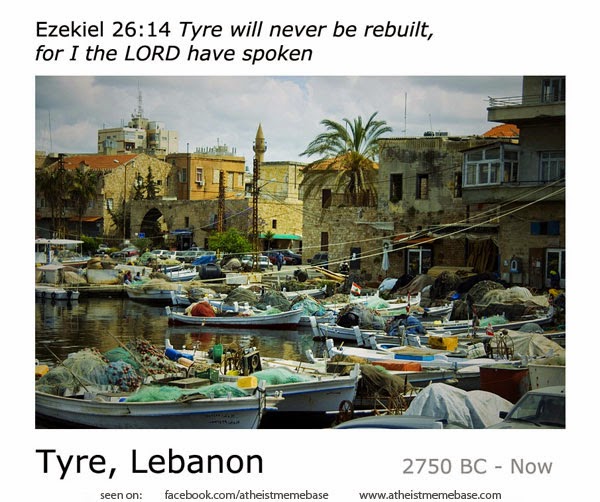
Failed prophecy about Tyre

With his prophecy of the destruction of Tyre, Ezekiel falls flat. God says (three times!) that Tyre will be destroyed, and never be built again.

26:7 For thus saith the Lord GOD; Behold, I will bring upon Tyrus Nebuchadrezzar king of Babylon, a king of kings, from the north, with horses, and with chariots, and with horsemen, and companies, and much people.
26:8 He shall slay with the sword thy daughters in the field: and he shall make a fort against thee, and cast a mount against thee, and lift up the buckler against thee.

26:14 And I will make thee like the top of a rock: thou shalt be a place to spread nets upon; thou shalt be built no more: for I the LORD have spoken it, saith the Lord GOD.

27:36 The merchants among the people shall hiss at thee; thou shalt be a terror, and never shalt be any more.

28:19 All they that know thee among the people shall be astonished at thee: thou shalt be a terror, and never shalt thou be any more.

Actually, Tyre still exists, and has for thousands of years. It’s on Wikipedia’s list of the oldest continuously inhabited cities in the world.

Even Jesus is said to have visited it. One wonders if he was puzzled by its persisting existence in defiance of his edict.

But then Ezekiel said the same thing about Egypt, and that didn’t happen.

29:9 And the land of Egypt shall be desolate and waste; and they shall know that I am the LORD: because he hath said, The river is mine, and I have made it.
29:10 Behold, therefore I am against thee, and against thy rivers, and I will make the land of Egypt utterly waste and desolate, from the tower of Syene even unto the border of Ethiopia.
29:11 No foot of man shall pass through it, nor foot of beast shall pass through it, neither shall it be inhabited forty years.

Oh, Ezekiel!

More of him next time.

OT Lesson 42 (Jeremiah 2)

“I Will Write It in Their Hearts”

Jeremiah 16; 23; 29; 31

LDS manual: here

Reading

Jeremiah was a bit of a drama guy. He liked to act stuff out. One time he broke a clay jar in front of a bunch of people, as a way of saying, “This is what God is going to do to you.”

19:1 Thus saith the LORD, Go and get a potter’s earthen bottle, and take of the ancients of the people, and of the ancients of the priests;
19:2 And go forth unto the valley of the son of Hinnom, which is by the entry of the east gate, and proclaim there the words that I shall tell thee,
19:3 And say, Hear ye the word of the LORD, O kings of Judah, and inhabitants of Jerusalem; Thus saith the LORD of hosts, the God of Israel; Behold, I will bring evil upon this place, the which whosoever heareth, his ears shall tingle.

19:10 Then shalt thou break the bottle in the sight of the men that go with thee,
19:11 And shalt say unto them, Thus saith the LORD of hosts; Even so will I break this people and this city, as one breaketh a potter’s vessel, that cannot be made whole again: and they shall bury them in Tophet, till there be no place to bury.

Another time he wore a yoke around his neck, like so:

27:2 Thus saith the LORD to me; Make thee bonds and yokes, and put them upon thy neck,
27:3 And send them to the king of Edom, and to the king of Moab, and to the king of the Ammonites, and to the king of Tyrus, and to the king of Zidon, by the hand of the messengers which come to Jerusalem unto Zedekiah king of Judah;
27:4 And command them to say unto their masters, Thus saith the LORD of hosts, the God of Israel; Thus shall ye say unto your masters;
27:5 I have made the earth, the man and the beast that are upon the ground, by my great power and by my outstretched arm, and have given it unto whom it seemed meet unto me.
27:6 And now have I given all these lands into the hand of Nebuchadnezzar the king of Babylon, my servant; and the beasts of the field have I given him also to serve him.
27:7 And all nations shall serve him, and his son, and his son’s son, until the very time of his land come: and then many nations and great kings shall serve themselves of him.
27:8 And it shall come to pass, that the nation and kingdom which will not serve the same Nebuchadnezzar the king of Babylon, and that will not put their neck under the yoke of the king of Babylon, that nation will I punish, saith the LORD, with the sword, and with the famine, and with the pestilence, until I have consumed them by his hand.

So, you know, he liked his props.

But because of the bad reviews, Jeremiah got pretty cranky. Murderously cranky. He asked God to kill everyone who didn’t believe him.

18:19 Give heed to me, O LORD, and hearken to the voice of them that contend with me.
18:20 Shall evil be recompensed for good? for they have digged a pit for my soul. Remember that I stood before thee to speak good for them, and to turn away thy wrath from them.
18:21 Therefore deliver up their children to the famine, and pour out their blood by the force of the sword; and let their wives be bereaved of their children, and be widows; and let their men be put to death; let their young men be slain by the sword in battle.

He was basically the angry guy at the train station muttering to himself.

Then the governor threw him in prison, and Jeremiah got so cranky, he told the governor that Jehovah was going to kill him and all his friends.

20:1 Now Pashur the son of Immer the priest, who was also chief governor in the house of the LORD, heard that Jeremiah prophesied these things.
20:2 Then Pashur smote Jeremiah the prophet, and put him in the stocks that were in the high gate of Benjamin, which was by the house of the LORD.
20:3 And it came to pass on the morrow, that Pashur brought forth Jeremiah out of the stocks. Then said Jeremiah unto him, The LORD hath not called thy name Pashur, but Magormissabib.
20:4 For thus saith the LORD, Behold, I will make thee a terror to thyself, and to all thy friends: and they shall fall by the sword of their enemies, and thine eyes shall behold it: and I will give all Judah into the hand of the king of Babylon, and he shall carry them captive into Babylon, and shall slay them with the sword.

And then he said he’d kill the entire world.

25:32 Thus saith the LORD of hosts, Behold, evil shall go forth from nation to nation, and a great whirlwind shall be raised up from the coasts of the earth.
25:33 And the slain of the LORD shall be at that day from one end of the earth even unto the other end of the earth: they shall not be lamented, neither gathered, nor buried; they shall be dung upon the ground.

One of the crimes of the Baal-worshippers was that they sacrificed their children, which Jehovah said hadn’t even occurred to him.

19:5 They have built also the high places of Baal, to burn their sons with fire for burnt offerings unto Baal, which I commanded not, nor spake it, neither came it into my mind:

No? What about Jephthah’s daughter? When Israelites sacrifice their children to Jehovah, they can’t stop talking about how great it is.

Anyway, what’s Jehovah going to do to show them that killing children is wrong? Make them eat their kids, of course.

19:9 And I will cause them to eat the flesh of their sons and the flesh of their daughters, and they shall eat every one the flesh of his friend in the siege and straitness, wherewith their enemies, and they that seek their lives, shall straiten them.

Sounds legit.

Main points from this lesson

God will write his law in the hearts of his people.

The real lesson manual says this:

• As recorded in Jeremiah 31:31–34, what did the Lord promise to do in the latter days?

31:33 But this shall be the covenant that I will make with the house of Israel; After those days, saith the LORD, I will put my law in their inward parts, and write it in their hearts; and will be their God, and they shall be my people.

What does it mean to have God’s law written in our hearts? What must we do to have God’s law written in our hearts?

I have to say that if God could write his law in people’s hearts, this would actually be a good way for a god to do things. At least, it would be far better than his current method of writing books. I’ve mentioned before that human language is a really terrible way for a god to get his message across because it’s imprecise, it changes over time, and it requires translation to get to different people. Each of those things allows for the introduction of error — and wiggle room for apologists. So it would really be quite sensible for a god to skip human language altogether, and just beam his message directly into people, so they’d know what he wanted.

Except it doesn’t work out that way. For one thing, if God is “writing his law in people’s hearts”, there sure is a lot of variation in the messages he’s sending them. Anyone who’s had a doctrinal disagreement with someone in church — and had the other person defend their view by saying “I’ve prayed about this” — knows that this is no way to defend a point of view. Why is it so easy to dismiss someone else’s view if God has written it in their hearts? Why would he have different people come to opposite conclusions?

When I was at the dear old Brigham Young University in 1986 — yes, that long ago — there was a production of West Side Story. (This was the official Drama department production; not the one I was in.) The big talk on campus was that a Black student named Michelle Harris didn’t get cast because she was Black. Pretty ironic, considering the anti-racism subject matter of the play. Here was the clincher, though. At the time, Harris told the media — and I can’t recover this from the Internet, so this comes from my imperfect memory — that she prayed to know whether she’d been discriminated against, and the Spirit™ told that indeed she had. I don’t doubt this was the case, but having lived in Utah, I didn’t need a ghost to tell me that. For her, though, this was good enough to take it public.

At the time, I was dismissive. Sure, I thought, revelation could tell you about the meaning of life and existence of a god, but surely it wasn’t reliable for that! But why not? Why didn’t I see that I didn’t really believe in personal revelation?

The Mormon community is composed of a lot of people driven by emotional reasoning. What a weird and irrational way for people to be.

Friedrich Nietzsche once said (or was it Dolly from the Nietzsche Family Circus)


Even if the law were written in our hearts, why would it be reliable? Jeremiah even warns:

17:9 The heart is deceitful above all things, and desperately wicked: who can know it?

Again, it would be incredibly useful for a god to communicate directly; the problem is that he doesn’t. He tells everybody something different, which is why religions proliferate.

Prophet v Prophet Deathmatch

There’s a great story here between Jeremiah and another prophet, Hananiah. Hananiah tells everyone that everything is going to be fine, and Babylon won’t invade.

28:2 Thus speaketh the LORD of hosts, the God of Israel, saying, I have broken the yoke of the king of Babylon.
28:3 Within two full years will I bring again into this place all the vessels of the LORD’s house, that Nebuchadnezzar king of Babylon took away from this place, and carried them to Babylon:

Jeremiah, still wearing his yoke, tells everyone (and rather snippily, too) that Babylon will in fact capture Israel.

28:6 Even the prophet Jeremiah said, Amen: the LORD do so: the LORD perform thy words which thou hast prophesied, to bring again the vessels of the LORD’s house, and all that is carried away captive, from Babylon into this place.
28:7 Nevertheless hear thou now this word that I speak in thine ears, and in the ears of all the people;
28:8 The prophets that have been before me and before thee of old prophesied both against many countries, and against great kingdoms, of war, and of evil, and of pestilence.

Yep, it’s a prophet-off.

So Hananiah, in a theatrical gesture, breaks the yoke off of Jeremiah’s neck!

28:10 Then Hananiah the prophet took the yoke from off the prophet Jeremiah’s neck, and brake it.
28:11 And Hananiah spake in the presence of all the people, saying, Thus saith the LORD; Even so will I break the yoke of Nebuchadnezzar king of Babylon from the neck of all nations within the space of two full years. And the prophet Jeremiah went his way.

Jeremiah can’t think of anything to say to that. But then later, he thinks of the perfect retort:

28:12 Then the word of the LORD came unto Jeremiah the prophet, after that Hananiah the prophet had broken the yoke from off the neck of the prophet Jeremiah, saying,
28:13 Go and tell Hananiah, saying, Thus saith the LORD; Thou hast broken the yokes of wood; but thou shalt make for them yokes of iron.

Don’t you hate it when you think of a great comeback, but it’s like the next day?

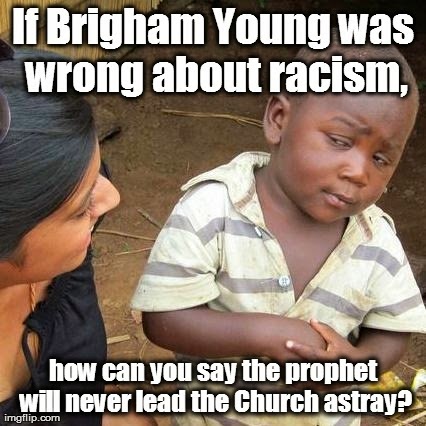
When two different people predict something, how do you know who’s right? Well, with science, it’s not impossible. You look at the different models, and see whose model best fits the data. But religion doesn’t have a good way of settling a situation where you have conflicting prophets. You have to either wait until the thing happens — in which case, what’s the point of having a prophet? — or God will kill the prophet who’s wrong, in which it becomes some kind of prophetic war of attrition. Again, what a strange and unreliable system.

Jehovah does kill Hananiah later on that year. Under ambiguous circumstances that could have been natural.

28:17 So Hananiah the prophet died the same year in the seventh month.

Say, is this where Mormons got the idea that God will kill any prophet who leads people astray?

Additional lesson ideas

Hunters and fishers

Here’s one from Jeremiah. Who are the ‘hunters and fishers’?

16:16 Behold, I will send for many fishers, saith the LORD, and they shall fish them; and after will I send for many hunters, and they shall hunt them from every mountain, and from every hill, and out of the holes of the rocks.

The real lesson manual explains:

Elder LeGrand Richards said that the fishers and hunters described in Jeremiah 16:16 are missionaries of the Church (in Conference Report, Apr. 1971, 143; or Ensign, June 1971, 98–99). What do fishers and hunters have in common with missionaries? (See Matthew 4:18–19.)

Answer: For both, after they catch something, the thing ends up dead. Notice also that animals and fish don’t want to be caught. They have to be grabbed. Tricked, if necessary.

Looking at investigators as prey is a very unhelpful way of looking at people with different beliefs. I say ‘unhelpful’ because of my own experiences as a missionary. We were told that success in the mission field was predicated on our obedience to mission rules and personal righteousness. It was as though we were trained to think of investigators as largely inert beings with no direction or history or thoughts of their own. They could be influenced to believe in our message because of things that we did.

But why would that be true? Imagine if that were the case. A family needs the gospel so they can return to live with Heavenly Father, but in order for God to make them feel inspired to join his church, God first demands that a couple of twenty-something missionaries starve themselves for a while. Whoops, one of them beat off a couple of times, so no eternal salvation for that family. It’s such a surreal scenario that I can hardly believe that I bought into it for so long.

Bad, evil, and naughty

The King James Version of Jeremiah shows us some interesting changes that were happening to English in Jacobean times. One concernes some very naughty figs.

24:2 One basket had very good figs, even like the figs that are first ripe: and the other basket had very naughty figs, which could not be eaten, they were so bad.

Nowadays, we think of naughty in a mischievous (and often a sexual) sense. But when the word first arose in about 1400, it meant ‘having nothing’ (from naught). It didn’t take long for the meaning to change into something different: by 1460, the word meant ‘bad’. Usually naughty was used for people,

Sir Richard Benet, parson of Estcodford, a nawghty man.

but also for food.

The bigaroon cherries..were fraudulent, sour, and naughty throughout

This meaning has faded since the 1600s, and in fact naughty isn’t as naughty as it used to be. Rather than describing someone of low character, it now could describe an impish child, or perhaps someone you’d like to meet.

If naughty has become nice, then evil has become downright debased.

24:3 Then said the LORD unto me, What seest thou, Jeremiah? And I said, Figs; the good figs, very good; and the evil, very evil, that cannot be eaten, they are so evil.

We don’t usually use evil to describe food (unless perhaps an evil smell is emanating from the kitchen). Evil has always been pretty evil since the word began in the 900s. For a time, though, the word was applied to things that were substandard or unwholesome, and this sense in captured in Jeremiah.

They govern themselves

Again, from the lesson manual:

• Joseph Smith was once asked how he successfully governed so many people. He said, “I teach the people correct principles and they govern themselves” (quoted by John Taylor, in Journal of Discourses, 10:57–58).

Ask: Do Latter-day Saints seem self-governed, or micro-managed?

If a church:

  • Tells you what to eat and drink
  • Tells you what to read
  • Tells you what kind of entertainment to select
  • Tells you what kind of cards not to use
  • Tells you what to do and what not to do on Sunday
  • Tells you what kind of artwork to have in your house
  • Tells you what you’ll be doing from ages 18–20 or so
  • Controls every aspect of your life during that time

then how is this allowing you to ‘govern yourself’? The ‘governing oneself’ style was probably never a part of the church, but it’s especially incompatible with the authoritarian religion that the LDS Church has become. Which is too bad.

OT Lesson 41 (Jeremiah 1)

“I Have Made Thee This Day… an Iron Pillar”

Jeremiah 1–2; 15; 20; 26; 36–38

LDS manual: here

Reading

Thank goodness we’re done with Isaiah. But no sooner do we get done with him then — oh, no — it’s Jeremiah. Jeremiah is just like Isaiah, except more depressing. This could be because, whereas Isaiah got to walk around naked a lot — some people find naturist culture very relaxing — Jeremiah spent a lot more time in dungeons. And little wonder: he scolds and harangues people, and then wonders why they can’t stand him. Jeremiah spent so much time haranguing people that he inspired a word for a long and tedious harangue against people: it’s a jeremiad.

And predictably, Jeremiah’s screed is full of blood and fire. There’s one thing we can say about the god of the Bible: he’s consistent. He tells people about the atrocious acts of murder he’s going to wage against them. For instance:

Jeremiah says that God is tired of holding back his fury, and wants to kill everyone.

6:11 Therefore I am full of the fury of the LORD; I am weary with holding in: I will pour it out upon the children abroad, and upon the assembly of young men together: for even the husband with the wife shall be taken, the aged with him that is full of days.
6:12 And their houses shall be turned unto others, with their fields and wives together: for I will stretch out my hand upon the inhabitants of the land, saith the LORD.

Their dead bodies will be eaten by birds and beasts.

7:33 And the carcases of this people shall be meat for the fowls of the heaven, and for the beasts of the earth; and none shall fray them away.

God will punish them by killing their sons and daughters.

11:22 Therefore thus saith the LORD of hosts, Behold, I will punish them: the young men shall die by the sword; their sons and their daughters shall die by famine:

And God will lift their skirts, non-consensually.

13:26 Therefore will I discover thy skirts upon thy face, that thy shame may appear.

But why is God going to kill everyone? Because their fathers didn’t believe in him enough.

16:10 And it shall come to pass, when thou shalt shew this people all these words, and they shall say unto thee, Wherefore hath the LORD pronounced all this great evil against us? or what is our iniquity? or what is our sin that we have committed against the LORD our God?
16:11 Then shalt thou say unto them, Because your fathers have forsaken me, saith the LORD, and have walked after other gods, and have served them, and have worshipped them, and have forsaken me, and have not kept my law;

Walked after other gods? Could you put this into a sexual metaphor for me?

3:1 They say, If a man put away his wife, and she go from him, and become another man’s, shall he return unto her again? shall not that land be greatly polluted? but thou hast played the harlot with many lovers; yet return again to me, saith the LORD.
3:2 Lift up thine eyes unto the high places, and see where thou hast not been lien with. In the ways hast thou sat for them, as the Arabian in the wilderness; and thou hast polluted the land with thy whoredoms and with thy wickedness.
3:3 Therefore the showers have been withholden, and there hath been no latter rain; and thou hadst a whore’s forehead, thou refusedst to be ashamed.

Keep going, but now incorporate primitive sex toys.

3:9 And it came to pass through the lightness of her whoredom, that she defiled the land, and committed adultery with stones and with stocks (trees).

I actually enjoy this imagery:

5:7 How shall I pardon thee for this? thy children have forsaken me, and sworn by them that are no gods: when I had fed them to the full, they then committed adultery, and assembled themselves by troops in the harlots’ houses.
5:8 They were as fed horses in the morning: every one neighed after his neighbour’s wife.

But remember: God is warning people about all the evil he’s going to do, so that maybe he won’t have to do all the evil to them. So that’s good.

36:3 It may be that the house of Judah will hear all the evil which I purpose to do unto them; that they may return every man from his evil way; that I may forgive their iniquity and their sin.

But “Obey me, or I will have you killed” is not much of a choice, is it? Many times in church, I would hear speakers or teachers say something like the following: “God gives us commandments, and invites us to obey. If we obey, we get blessings, and if we don’t, then there will be consequences to our actions.” Which is all very well, but the picture that emerges from our reading of the Old Testament is that God gives commandments, and then threatens us with death if we don’t obey them (or if our fathers don’t).

At least at this stage in the OT, the threats only extend to death. Jesus will update that to include eternal punishment in hell.

Main points from this lesson

Is it good to be ‘an iron pillar’?

Jeremiah says God told him this:

1:18 For, behold, I have made thee this day a defenced city, and an iron pillar, and brasen walls against the whole land, against the kings of Judah, against the princes thereof, against the priests thereof, and against the people of the land.

In case the class hasn’t seen anything made of iron before, the real lesson manual helpfully suggests:

Display a metal bar and invite a class member to try to break it. Then ask the following questions:
• If this object represented a person’s characteristics, what would it suggest about him or her?

I imagine they’re shooting for ‘strong’, which is very positive. But take a guess: is it positive in the following scripture?

Isaiah 48:4thy neck is an iron sinew, and thy brow brass;

Answer: Not here. Here, it’s symbolic of an inflexible nature. For Jehovah, it’s bad to be inflexible by not believing in him, but good to be inflexible in his service — just like with murder, genocide, and a lot of other nasty things.

One of the things I’ve been learning (post-religion) is the importance of being able to change my mind when the facts require. It’s one of science’s great strengths that it can update to accommodate new facts. And it’s good to be able to change one’s mind on an individual level, as everything we think is probably at least a little bit wrong.

Richards Dawkins tells this story:

I have previously told the story of a respected elder statesman of the Zoology Department at Oxford when I was an undergraduate. For years he had passionately believed, and taught, that the Golgi Apparatus (a microscopic feature of the interior of cells) was not real: an artifact, an illusion. Every Monday afternoon it was the custom for the whole department to listen to a research talk by a visiting lecturer. One Monday, the visitor was an American cell biologist who presented completely convincing evidence that the Golgi Apparatus was real. At the end of the lecture, the old man strode to the front of the hall, shook the American by the hand and said–with passion–“My dear fellow, I wish to thank you. I have been wrong these fifteen years.” We clapped our hands red. No fundamentalist would ever say that. In practice, not all scientists would. But all scientists pay lip service to it as an ideal–unlike, say, politicians who would probably condemn it as flip-flopping. The memory of the incident I have described still brings a lump to my throat.

I respect Dawkins most when he admits his lack of knowledge in some area, as in this clip (question starts at 38:04, Dawkins’ comment at 47:50)

Chairman: I just want to hear from Richard Dawkins. The same debate essentially has been going on in the U.K. and in fact right across Europe. Your thoughts on hearing it repeated here?
Richard: I’ve been rather moved to hear the very humane statements that have been made. I don’t feel I should contribute to this debate. I know nothing about the Australian situation, but I was moved especially by what the Rabbi was saying.

And I respect him least when he’s dismissive of others, as in his recent Twitter squabbles.

As for me, I love being wrong. Well, not really — does anyone? But once I was talking to a listener of my podcast (Talk the Talk), and she said, “Have you ever gotten something wrong?” I thought for a second, and had to say, “No, I haven’t.” But then I realised, with some horror: I have gotten it wrong, and I just don’t know it!

Then on a later episode, someone pointed out that I’d made a mistake. And I thought, thank goodness! What a relief! For one thing, I didn’t have to think that wrong thing anymore, so I knew more than before. And for another, someone’s noticing my mistakes, so I’ve probably gotten most of the other things right, otherwise someone would have said something.

This willingness to change my mind is part of why I do this blog, and why I engage with believers. If I’m wrong about this religion thing, someone will tell me, and if they have the facts, I can be convinced. Based on the last million interactions, it’s not looking good, and I’m not holding my breath. It would take an awful lot to convince me that all the immoral things we’ve read are moral. If someone were able to convince me, it might have more to do with my moral failure than with their having a good argument. After all, what could make this god’s actions moral? But I have to, at least in theory, keep the door open, keep talking, and keep engaging. Not be iron.

“Before I formed thee in the belly I knew thee”

Mormons use this scripture to support the notion of a pre-mortal life.

1:5 Before I formed thee in the belly I knew thee; and before thou camest forth out of the womb I sanctified thee, and I ordained thee a prophet unto the nations.

I’ve mentioned before that the pre-mortal life was one of my favourite Mormon doctrines, mostly because of an epiphany I used to have when seeing tons of people at once in a public place. Oh, look, I’d think, all my brothers and sisters from the realms of glory, etc. It was a lovely thought, and after deconversion, one that I hated to lose. I didn’t think I’d ever have access to that again.

Of course, there are some aspects of the pre-mortal life that aren’t so lovely. It means that God made a whole lot of people, knowing in advance that they wouldn’t make it to the Celestial Kingdom, and that they’d therefore face eternal separation from their families / God / Ed McMahon and so forth. Why would his perfect system involve exclusion and isolation for so many? Not too cool, God. Why didn’t he use his all-knowingness to know who would make it back to his presence, and only create those people? Why wouldn’t he make a bar that everyone could clear? And the answer is that the system doesn’t have a way of controlling you if you don’t have something to lose.

A bit of an update: One bright, sunny day at the university where I teach, I was walking to my office, and noticing all the terrific students around the place. So many smart people! All a little different from each other; all carrying different DNA. And I started thinking about evolution, and how the genes of everyone that I was seeing had combined in partly random ways from parents to make gazillions of different people, walking around here on earth. I realised that was we call ‘humankind’ was nothing less than the sum total of all the humans who were alive today, and here we were, and it was all happening now! And we were all related! Wow!

It was the pre-mortal epiphany again. I was very pleased to find that, despite my lack of belief, I hadn’t lost access to it. But this time it was based in something real, and no less inspiring.

Additional lesson ideas

Of leopards and spots

You’ve probably heard people say “A leopard can’t change its spots” as a way of referring to the immutability of personality or motivation. Well, that saying comes from Jeremiah, except with a slight twist:

13:23 Can the Ethiopian change his skin, or the leopard his spots? then may ye also do good, that are accustomed to do evil.

It’s probably good that we don’t say the first part anymore. Totally not cool, Bible.

Don’t have Christmas trees

Jeremiah appears to condemn Christmas trees.

10:1 Hear ye the word which the LORD speaketh unto you, O house of Israel:
10:2 Thus saith the LORD, Learn not the way of the heathen, and be not dismayed at the signs of heaven; for the heathen are dismayed at them.
10:3 For the customs of the people are vain: for one cutteth a tree out of the forest, the work of the hands of the workman, with the axe.
10:4 They deck it with silver and with gold; they fasten it with nails and with hammers, that it move not.

Of course, Jeremiah — having no actual prophetic powers — wasn’t referring specifically to Christmas trees. People don’t nail Christmas trees to the floor, anyway, but that’s easy to overlook when you read this passage and think “Christmas tree”. But it’s fun to float this scripture in a real Gospel Doctrine class, and watch the gymnastics that follow.

What’s with deck, anyhow? When we talk about decorating things, there’s nothing we would say that we deck. The usefulness of this word would appear to have shrunk to halls and trees.

Here’s the story. The word comes from Middle Dutch dekken, “to cover”, so you deck a tree when you cover it. For that matter, the deck of a boat is the part that covers the boat, so that’s related, too. And when you deck someone, you lay them out on the deck. (Those sailors; always fighting.) It’s fun to see how the meaning of words coincide.

Closing hymn

Here’s one of the more desolate passages from Jeremiah.

8:15 We looked for peace, but no good came; and for a time of health, and behold trouble!
8:16 The snorting of his horses was heard from Dan: the whole land trembled at the sound of the neighing of his strong ones; for they are come, and have devoured the land, and all that is in it; the city, and those that dwell therein.
8:20 The harvest is past, the summer is ended, and we are not saved.
8:22 Is there no balm in Gilead; is there no physician there? why then is not the health of the daughter of my people recovered?

That sounded pretty good, but it would sound better if it were set to music by… oh, say… Ralph Vaughan Williams. And look! it is. Here’s his Dona Nobis Pacem.

The whole thing is good, mostly thanks to the poetry of Walt Whitman, but for this lyric, start at 28:11.